
Summer 2027 Internships: When Applications Actually Open
Summer 2027 internship applications open earlier than most students think. Here is the real timeline by industry, plus roles already live now.

10 min read
Somewhere right now a sophomore is opening a fresh spreadsheet to track summer 2027 internships, and somewhere else a bank has already closed the application that spreadsheet was built for. That gap is the whole problem. Not effort, not qualifications: timing.
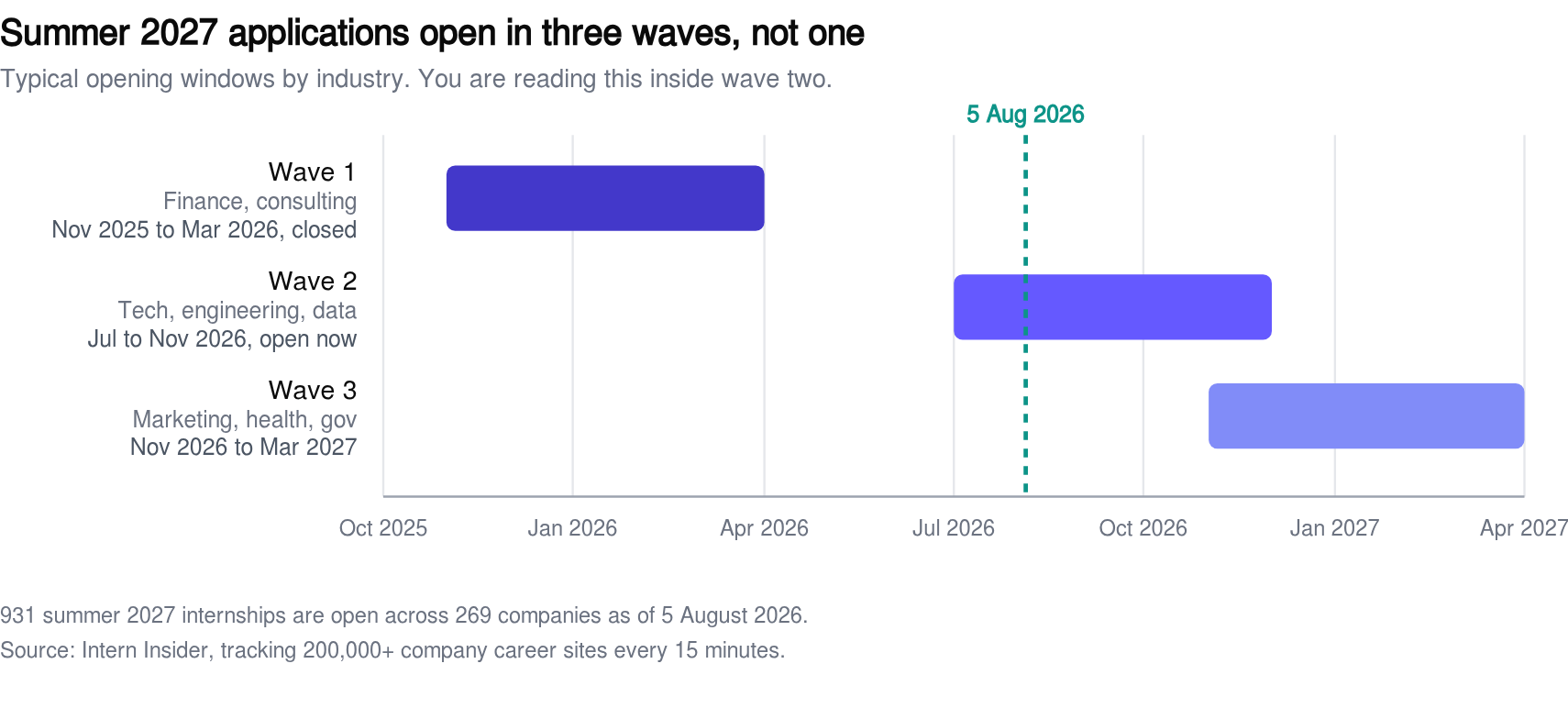
Here is the part nobody tells you clearly. There is no single opening date for summer 2027 internships. There are three separate waves, running roughly nine months apart end to end, and the wave your industry sits in decides whether "early" means this August or next February.
We track 200,000+ company career sites every 15 minutes, which means we watch these waves break in real time rather than reconstructing them afterward. As of 5 August 2026 there are 931 summer 2027 internships open across 269 companies, and 379 of those were added in the past seven days. Some of them opened while this guide was being written.
The short answer: three waves, not one deadline#
| Wave | Who recruits | Typical opening window | How fast it closes |
|---|---|---|---|
| One | Investment banking, sales and trading, MBB consulting | Late 2025 through March 2026 | Weeks. Rolling review, first-round interviews before the window shuts |
| Two | Big tech, engineering, data, aerospace and defense | July through November 2026 | Days to weeks for the largest programs |
| Three | Marketing, media, healthcare, government, nonprofits, design | November 2026 through March 2027 | Slower, but the best-known programs still fill early |
If you are reading this in August 2026, you are early for wave three, on time for wave two, and late for wave one. That is not a failure. It is a map.
Wave one: finance and consulting recruit almost a year ahead#
Finance moved first and never moved back. Bulge-bracket and elite boutique banks now open summer analyst applications for the following year in the late autumn and winter of the year before, which means the summer 2027 analyst class was largely built during late 2025 and the first quarter of 2026.
Strategy consulting runs a similar calendar with a different shape. The largest firms typically open a first round in the first quarter, interview quickly, and hold a smaller second round later.
What this means in practice:
If you want banking or MBB for summer 2027 and you have not applied, the main round has passed. Off-cycle roles, boutiques, regional firms and second-round consulting slots are the realistic path.
If you are targeting summer 2028, your clock starts around October 2026. That is roughly two months from now.
The part that catches people out#
Wave-one employers do not wait for the posted deadline. Applications are reviewed on a rolling basis, which means the deadline is the last possible date, not the date decisions get made. A posting open until March with rolling review is functionally a January posting with a March safety net.
Wave two: tech, engineering and data open through this autumn#
This is the wave that is breaking right now.
Software, data and IT. The largest technology employers typically post summer internships between July and October, and the very biggest programs are the shortest. It is common for a headline tech internship to stay open for a matter of weeks, sometimes less, and to close before most students have finished their first week of the autumn term.
Engineering. Aerospace and defense contractors move first, often from August, driven by clearance and onboarding lead times. Mechanical, civil, electrical and biomedical programs cluster from September into January. If you are an engineering student, September and October are your months. Across every term on the board there are 459 open engineering roles today: 183 in civil and structural, 131 in electrical, 100 in mechanical, and 45 in chemical and materials.
Data and analytics. Sits between the two, typically July through November, with a long tail of smaller employers into the new year.
For a discipline-by-discipline breakdown of who hires and when, our engineering internships guide covers all four major disciplines. If you are in software or data, computer science internships beyond the big tech pipeline covers where the less obvious roles live.
Wave three: everything else, from November onward#
Marketing, media, healthcare, government, nonprofits, design and the arts run later and slower. Windows commonly open from November 2026 and run into March 2027, and some government programs run later still because of background-check timelines.
Later does not mean easier. A well-known museum, studio or agency program can be more competitive than a mid-size tech internship, because the applicant pool is national and the intake is often a handful of people.
Why "rolling" is the word that should worry you#
Almost every one of these windows is reviewed on a rolling basis. That single word changes the strategy completely.
Under rolling review, applications are assessed as they arrive. Interview slots are offered to strong early applicants, and by the time the posted deadline arrives, a substantial share of the class is already spoken for. The deadline is a formality. The real deadline was the day the recruiter had enough good candidates to fill the first interview round.
So what does that actually mean for you? It means the calendar matters more than the cover letter. A very good application submitted in week six competes against a shortlist that already exists. A decent application submitted in week one helps create it.
The month-by-month plan from here#
You are reading this in August 2026. Here is what each month between now and next spring is actually for.
| Month | What opens | What you do |
|---|---|---|
| Aug 2026 | Aerospace, defense, early big tech, some engineering | Resume finalised. Alerts set. Apply to everything already live in your field |
| Sep 2026 | Engineering broadly, more tech, first consulting pre-season | Apply weekly. Start outreach to recruiters at your top ten |
| Oct 2026 | Peak big tech, wave-one opens for summer 2028 | Highest-volume month. If you do one thing all year, do October properly |
| Nov 2026 | Wave three begins, tech tail continues | Widen to marketing, healthcare, media if relevant |
| Dec 2026 | Quieter posting month, heavy interview month | Interview prep. Follow up on anything silent for three weeks |
| Jan 2027 | Wave three peak, second-round consulting | Second push. Many students stop here, which is exactly why it works |
| Feb 2027 | Government, nonprofits, smaller employers | Apply to the roles with longer processing timelines |
| Mar 2027 | Late postings, backfills, dropped offers | Backfills are real. Keep alerts on through spring |
What being early actually looks like#
"Apply early" is advice that survives because it is impossible to argue with and easy to ignore. Here is the operational version of it, which is a different thing.
Your resume is finished before the wave, not during it. The students who apply in week one are not faster writers. They finished the document in July. Once a wave opens, every hour spent editing a bullet point is an hour a posting sits unanswered.
Alerts replace checking. Manually checking twenty career sites is a habit that survives about nine days. An alert on a role and a location survives the entire cycle. This matters more than it sounds, because the roles worth having are frequently open for less time than the gap between two manual checks.
You apply on a schedule, not on a mood. Two fixed sessions a week, an hour each, beats an all-nighter in October every time. Rolling review rewards consistency across a window, not volume on one day.
You track what you sent. Not for tidiness. Because follow-up at the three-week mark is the cheapest interview you will ever get, and it is impossible without a record.
None of that requires talent. It requires starting before the thing you are waiting for starts.
A note on Canadian timing#
The waves above hold in Canada, with two differences worth planning around.
The first is co-op. If you are in a co-op program at a Canadian university, your placement calendar is set by your co-op office and it may not align with the general market at all. Registration deadlines and employer-approval rules come first, and a role you find yourself may still need to be approved to count toward your requirement. Check with the office before you accept anything. Our guide to co-op versus internship in Canada covers how the two systems differ.
The second is that Canadian postings tend to run slightly later than their US equivalents in the same industry, particularly outside finance. If you are applying in both countries, treat the US calendar as your deadline and the Canadian one as your extension, not the reverse. Toronto, Vancouver, Calgary and Montreal each run on their own local hiring rhythm, which our guide to internships and co-op jobs by city breaks down.
What to do if you are reading this late#
Being late to a wave is not the same as being out of a season. Three things genuinely work.
Go where the calendar has not closed. Mid-size and regional employers run months behind the household names for the same roles, often with better mentorship and a shorter interview process.
Watch for backfills. Students accept offers and then accept better ones. Those seats reopen quietly, usually without a fresh announcement, which is exactly the kind of change a crawler catches and a weekly newsletter does not.
Apply where the posting actually lives. Roughly half of the best internships never make it to the large aggregators at all. Companies post to their own career site first, sometimes exclusively, and the role is filled before it ever syndicates. That is the single biggest reason a student can apply to 200 roles and hear nothing: the good ones were never in the pile.
This is why our links go straight to the employer's own posting rather than through a third-party application flow. Fewer steps between you and the person reading applications, and no intermediary deciding what you see.
One student had spent two full recruitment cycles applying without an offer, then landed one within a month of switching to roles found this way. The applications were not better. The list was.
Where summer 2027 roles are posted right now#
931 summer 2027 roles are live across 269 companies as of 5 August 2026, with 379 added in the past week. For context on the wider board, there are 9,412 open internships from 2,698 companies across all terms right now. Those numbers move every 15 minutes, which is how often we re-check every company site we track.
You can browse the full summer 2027 collection, or start with what was posted most recently if you want to see the wave breaking in order. If timing is what you care about most, fall 2026 internships that are still open covers the season that closes first, and internships for college freshmen covers where to start if this is your first cycle.
For the broader picture of how internship hiring is moving across employers generally, the National Association of Colleges and Employers publishes the industry's benchmark data on internship and co-op hiring.
The one habit that outperforms everything else#
If you do nothing else from this guide, do this: set an alert for your field and your location today, and stop checking manually.
The arithmetic is straightforward. The strongest roles in wave two stay open for a matter of weeks, sometimes less. A student checking career sites manually does so, realistically, every eight to twelve days once term starts. That gap is frequently longer than the window itself, which means the roles you most want are the ones you are least likely to see.
An alert closes that gap to hours. It is the single cheapest intervention available in the whole recruiting process, it takes about a minute, and it is the difference between applying in week one and finding out in week five that the posting closed.
Everything else in this guide is about which door to walk through. This is about being there when it opens.
Frequently Asked Questions#
When do summer 2027 internships open? In three waves. Finance and consulting opened between late 2025 and March 2026. Tech, engineering and data open between July and November 2026. Marketing, healthcare, government and creative fields open from November 2026 into March 2027.
Is August 2026 too early to apply for summer 2027? No. For engineering, aerospace, defense and big tech it is exactly right. Roles are already live and being reviewed.
Is it too late for summer 2027 investment banking? For the main summer analyst round at large banks, yes. Boutiques, regional firms, off-cycle roles and second-round consulting remain realistic.
How many internships should I apply to? For competitive fields, plan on 15 to 25 well-targeted applications rather than a hundred generic ones. Under rolling review, twenty applications sent in the first two weeks of a window will beat a hundred sent across six months.
Do internships still get posted after the deadline? Yes. Backfills happen throughout spring when accepted offers are declined. They are rarely announced, which is why alerts beat manual checking.
What is the single highest-leverage month? October 2026. It carries the peak of the tech and engineering wave for summer 2027 and the opening of wave one for summer 2028 at the same time.
Summer 2027 hiring is not one race with one starting gun. It is three, and the only real mistake is running the wrong one. Find the wave your field sits in, apply in the first two weeks of it, and let the alerts handle the rest. Browse open Internships to see what is live in your field today.
Found this useful? Pass it along.